


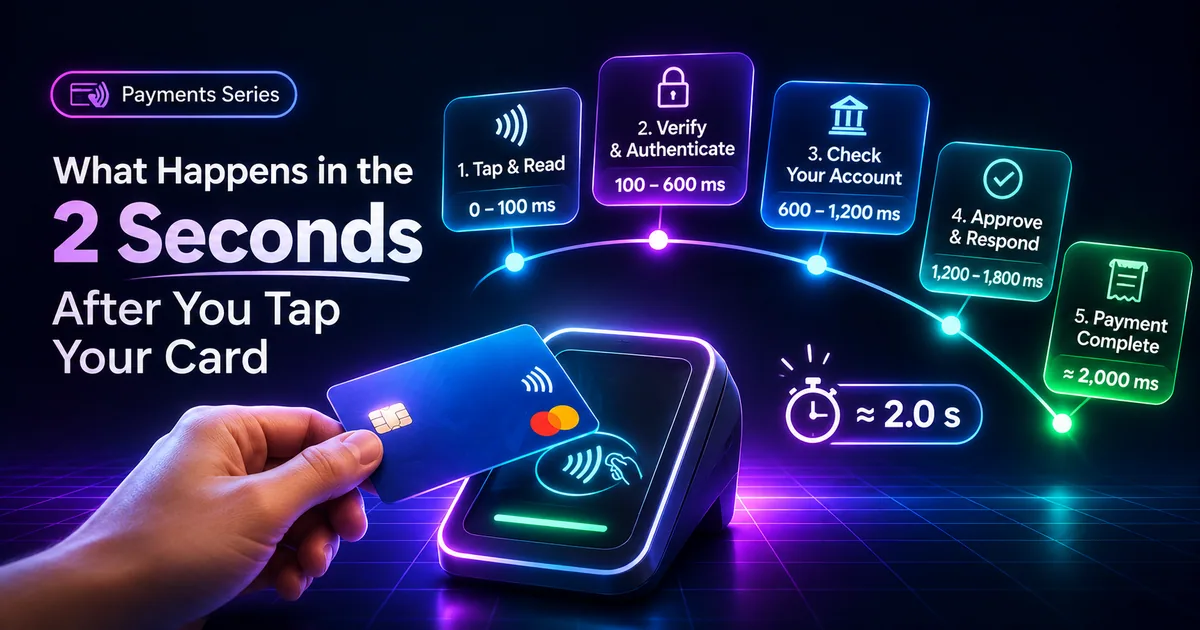
Beep. “Approved.” It feels like nothing happened. In reality, a message just crossed several companies, maybe several countries, passed fraud checks — and still, no money has moved.
The five players
- You (the cardholder) and your bank (the issuer).
- The merchant and its bank (the acquirer).
- The processor / gateway (Stripe, Adyen, a terminal provider) connecting the merchant to everything.
- The card network (Visa, Mastercard…) — the roads between banks.
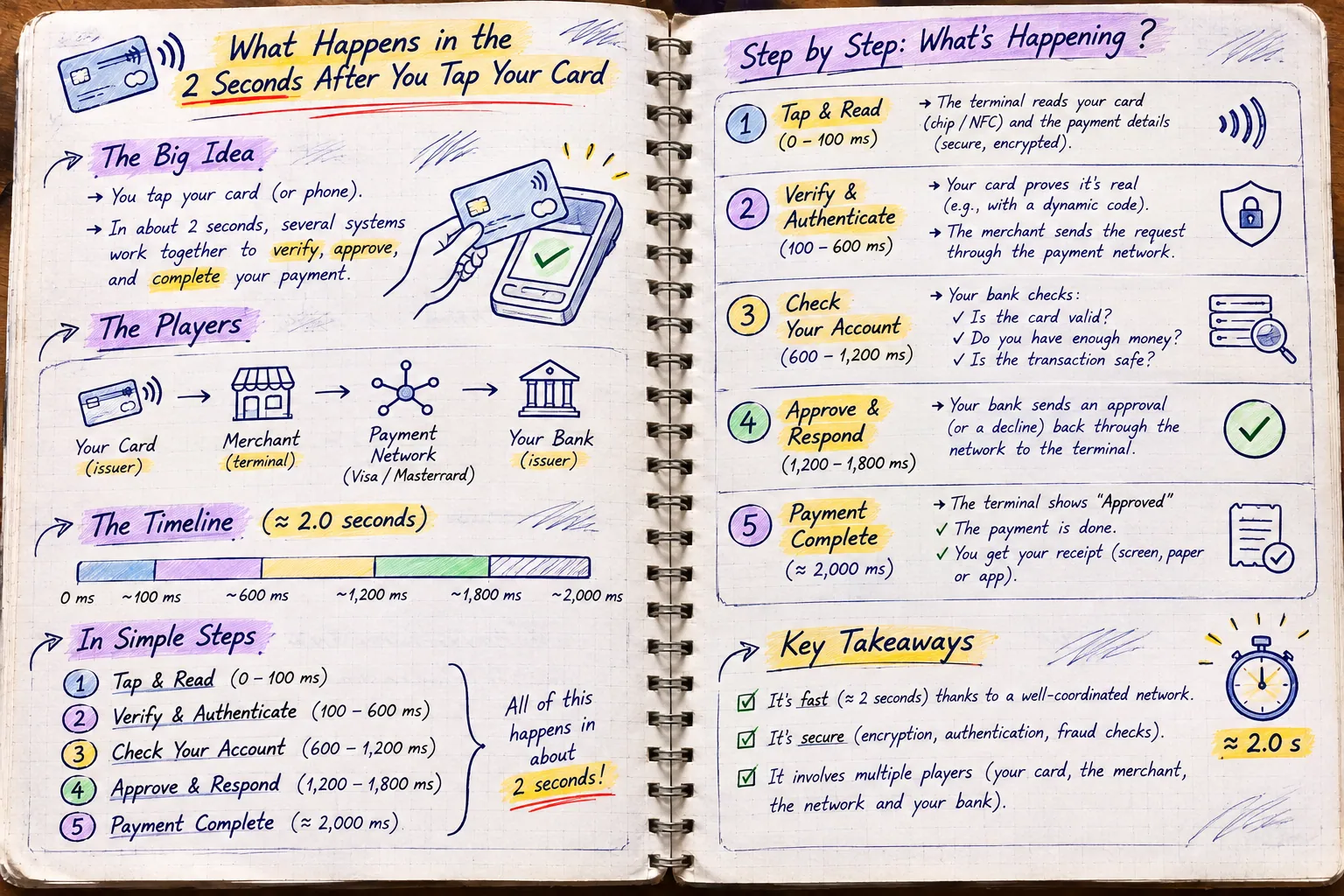
Follow the payment
You → Merchant · Tap / card detailst≈0 ms
Your phone or card sends an encrypted, one-time cryptogram — modern payments never reuse the real card number (tokenisation).
- Merchant keeps $97.35
- Your bank (interchange ~1.8%): $1.80
- Card network (~0.15%): $0.15
- Processor (~0.6% + $0.10): $0.70
Fee bars exaggerated ×6 for visibility. Typical US credit-card example; EU caps consumer interchange at 0.3%.
Approval isn't payment
The approval only creates a hold on your money. That's why hotels can “pre-authorise” more than the bill and why transactions appear as pending. The actual transfer happens later in batches: clearing and settlement.
Quick check
A shop gets “approved” for your $50 payment. When does the shop's bank actually receive the money?
Who takes what
On a typical card payment the merchant receives slightly less than the price. Most of the difference goes to your bank as interchange — which pays for fraud protection, credit and… your card's cashback and points.
Your “free” cashback is paid by the shop, which bakes it into prices for everyone.
For business owners
- Compare blended (one flat %) and interchange-plus pricing — the second is often cheaper at volume.
- Online, use a processor with 3-D Secure and good fraud tools — chargebacks cost more than fees.
- Offer local methods your customers trust (cards, wallets, bank transfers) to raise checkout conversion.