

Put them on, flip a switch, and a plane's roar disappears. The headphones aren't just blocking sound — they're creating sound to destroy sound.
Sound is a wave
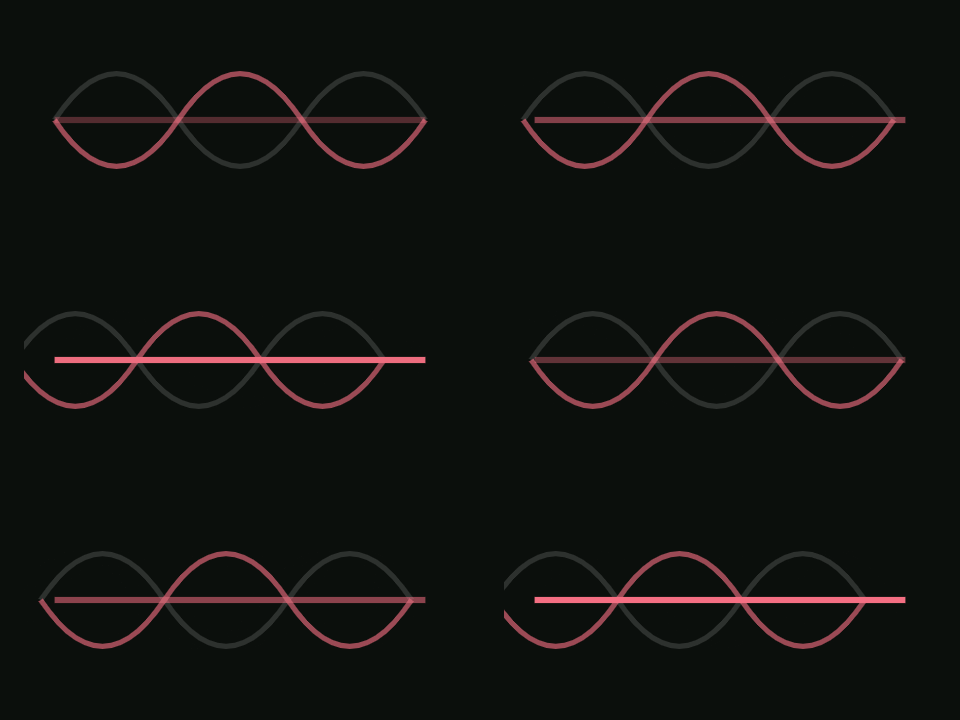
Sound is tiny pressure changes in the air: peaks (compressed air) and troughs (thinner air). If you add a second wave whose peaks line up exactly with the first wave's troughs, they sum to zero. Physicists call it destructive interference.
Cancel a wave yourself
Start at 100 Hz (engine hum). Then slide to 2,000 Hz without changing the delay. Then reduce the delay.
Noise reduced by ~24 dB
phase error 4°Inside the headphones
- Outer microphones hear noise before it reaches your ear (feedforward).
- Inner microphones hear what's actually left in your ear (feedback).
- A chip computes the inverted wave thousands of times per second.
- The speaker plays your music + the anti-noise.
Silence, in your headphones, is a sound being played very precisely.
Why voices get through
A delay of 100 µs is nothing for a 100 Hz wave (one cycle = 10,000 µs), but at 2,000 Hz it's a big chunk of a cycle (500 µs) — the anti-noise arrives out of step. Voices and keyboard clicks are higher and change constantly, so they're hard to predict.
- A good ear seal (right tip size) blocks the high frequencies physically.
- Transparency mode does the opposite: mics pass outside sound in on purpose.
Quick check
Which noise will ANC cancel best?