
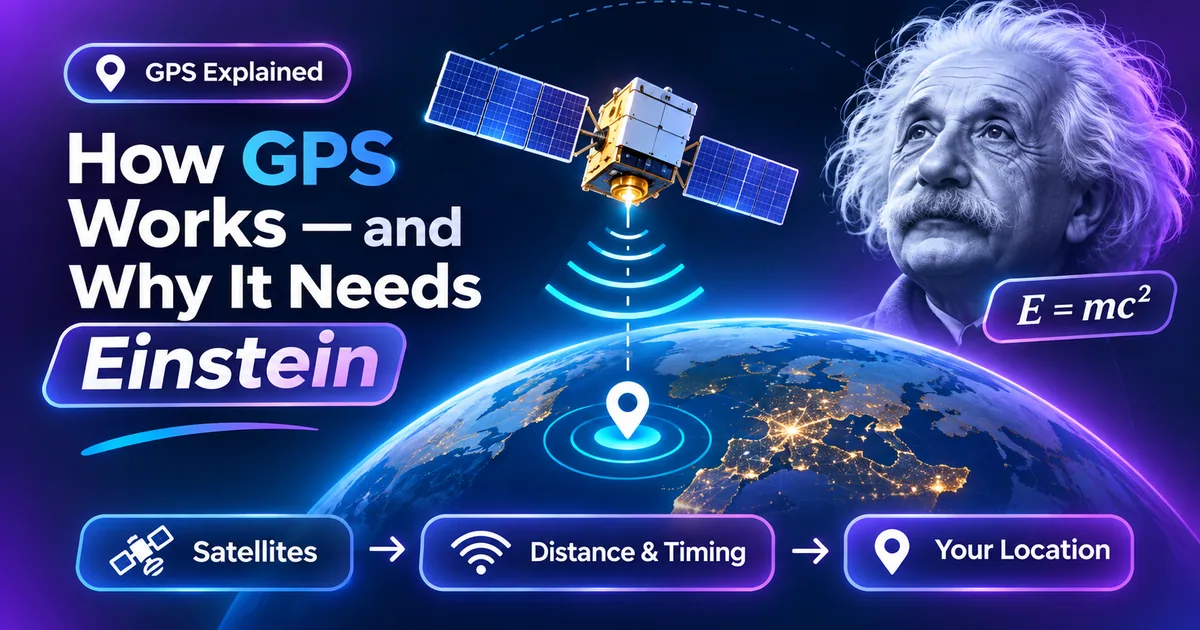
Open a map and a blue dot appears — even in airplane mode. No signal is sent from your phone to space. So how does it know? The answer involves circles, atomic clocks and Albert Einstein.
Your phone only listens
About 30 GPS satellites orbit ~20,200 km above Earth. Each one continuously broadcasts: “I am satellite X, I am here, and the time is exactly T.” Your phone is a radio receiver. It never talks back — which is why GPS works for billions of devices at once.
Distances become circles
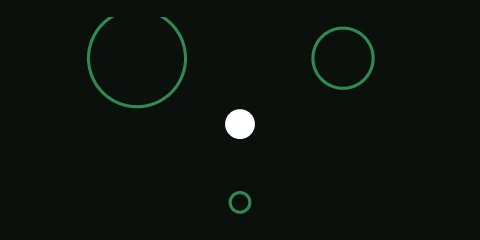
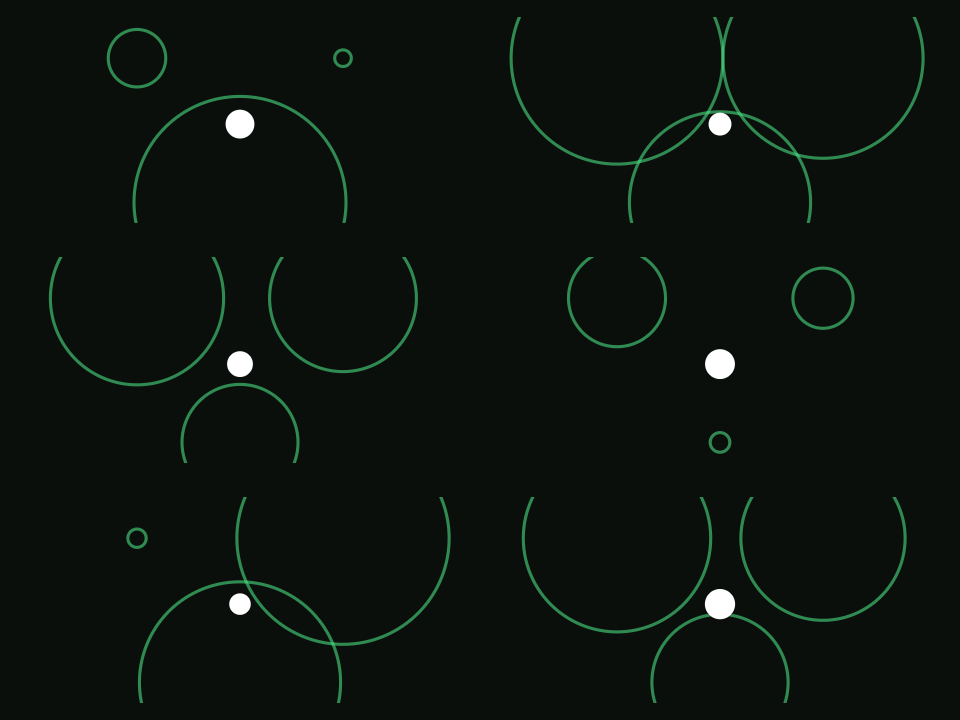
If a signal took 0.07 seconds to arrive, it travelled 0.07 × 300,000 km/s ≈ 21,000 km. You are somewhere on a sphere of that radius around the satellite. With three satellites, the spheres meet at a point.
Drag the phone. *Map distances are scaled down; real satellites orbit ~20,200 km up.
Everything is about time
Light travels about 30 cm per nanosecond. Be off by one millionth of a second and your position is off by 300 metres. That's why every satellite carries atomic clocks.
Your phone has a cheap clock, so it uses a trick: it listens to a fourth satellite and solves for its own clock error as an extra unknown.
Quick check
Why does a GPS receiver need at least 4 satellites, not 3?
The Einstein correction
- Special relativity: satellites move at ~14,000 km/h, so their clocks tick slower by ~7 µs/day.
- General relativity: gravity is weaker up there, so clocks tick faster by ~45 µs/day.
- Net: +38 µs per day. The satellite clocks are deliberately tuned slower before launch.
Every time you use a map, you're running a daily experiment that proves Einstein right.
Why your phone is even better
- Multiple systems: GPS (USA), Galileo (EU), GLONASS (Russia), BeiDou (China) — more satellites, better accuracy.
- Dual-frequency receivers correct for delays in the atmosphere.
- Assisted GPS: Wi-Fi and cell towers give a rough position instantly while satellites lock on.